Case studies AI Training · Cohort
A marketing team stops renting badge scanners.
Inside an aerospace manufacturer’s automation cohort, the marketing team mapped what trade-show lead capture cost them each year, then replaced rented badge scanners with a phone form that puts each lead straight into the CRM.
An aerospace manufacturer. Name withheld.
- About $80,000
- a year, the mapped cost of the old process
- $500
- badge scanner fee per show, no longer paid
- $40,000 to $60,000
- a year, measured by each project in the second cohort round
- 3 countries
- where the cohort has run: the United States, France, and Spain
Where it started
A hundred shows a year, and a spreadsheet after each one.
Our founder ran this program from the inside, as the manufacturer’s director of marketing and then its first director of AI and data, before Civic Dialog became a full-time practice. The cohort teaches employees to scope, build, and measure their own automations. The marketing team’s trade-show process was the pilot, and it is the example the later rounds were taught from.
The team attended about a hundred trade shows a year. Roughly eighty of them charged about $500 for a badge-scanning app. After each show the vendor sent a spreadsheet that did not match the CRM, someone cleaned it by hand, and salespeople wrote their follow-up emails from memory.
01 Discover
Map the process and price it
The cohort starts with a process map and a cost, using Lean Six Sigma root-cause tools. Nobody builds until the baseline is written down.
Scanner fees
About eighty shows a year at roughly $500 each for the badge-scanning app: about $40,000 a year before anyone had spoken to a lead.
Cleanup and import
About an hour per show reformatting the vendor’s spreadsheet for the CRM. State names spelled out where the CRM wanted abbreviations, and a dozen problems like it.
Follow-up by hand
Leads were assigned by geography, not by who met the person. Salespeople wrote generic follow-up emails one at a time, days after the conversation.
02 Architect
Use the tools already paid for
The design rule for a cohort project: no new platform. The team already had a form tool, Zapier, HubSpot, and a working sync to Salesforce.
A phone replaces the scanner
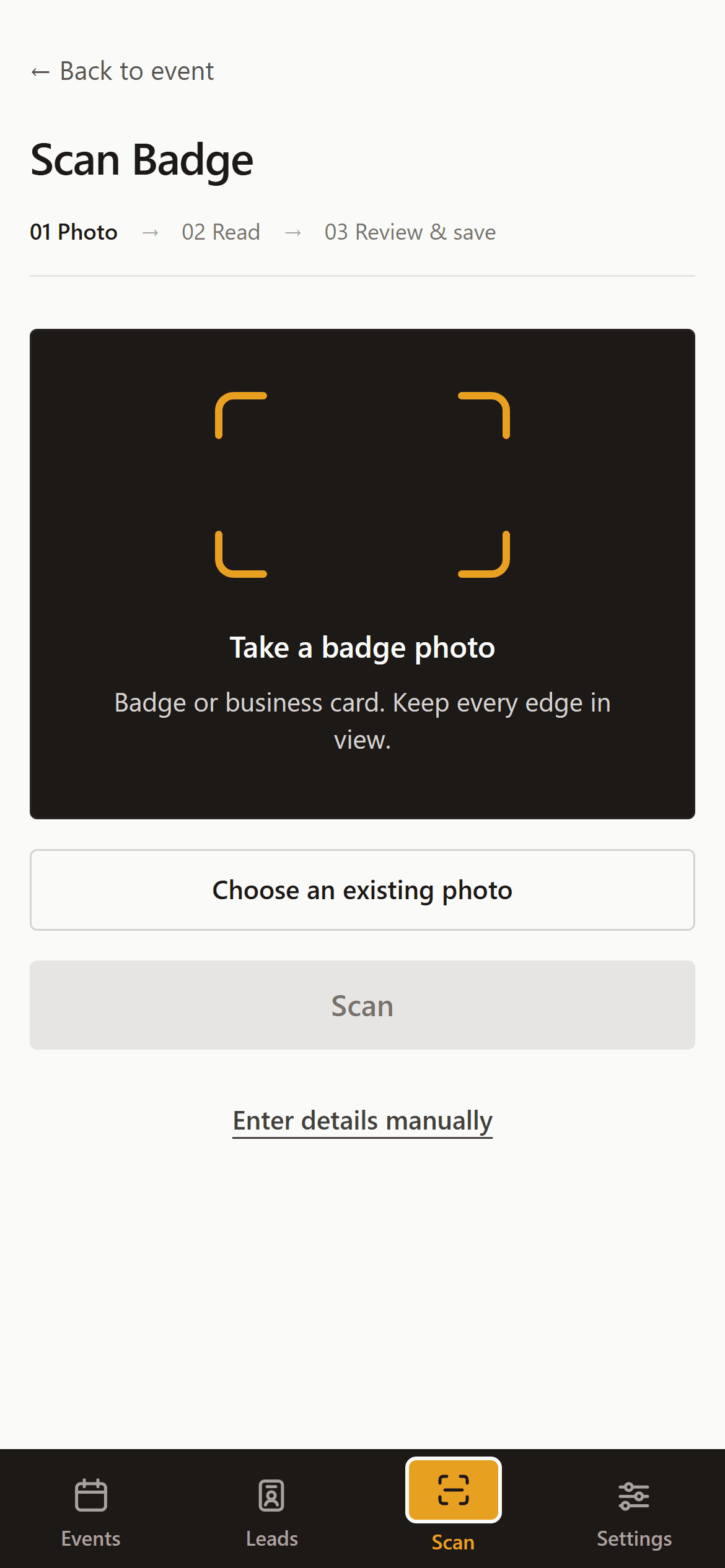
A salesperson photographs a badge or a business card in a form on their own phone. A hidden token in the link records who took the picture, so the lead belongs to the person who met them.
AI does the reading, not the deciding
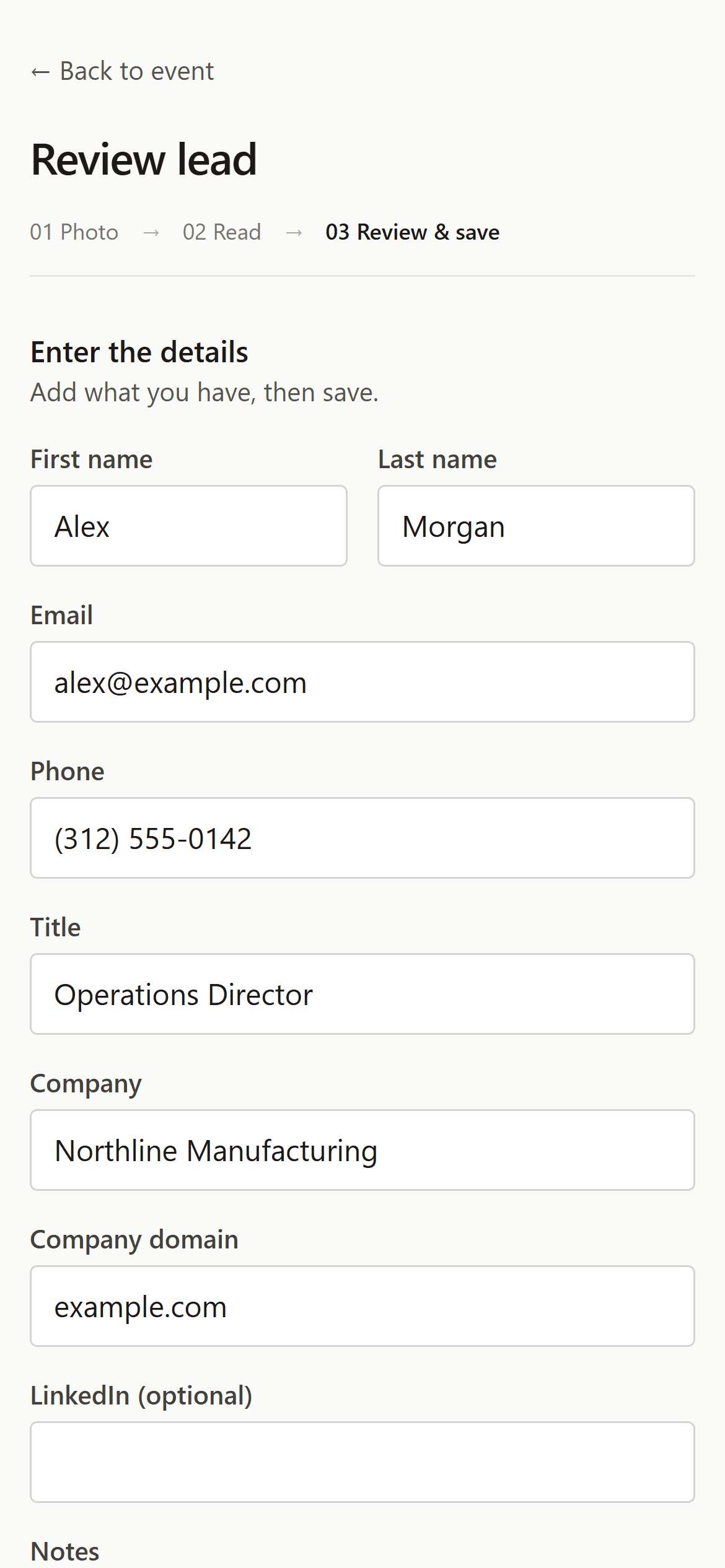
A language model extracts the fields from the photo and writes them in the exact format the CRM expects. It also researches the company and drafts a follow-up.
A person sends the email
The draft goes to the salesperson to review, edit, and send. The follow-up is the one step where judgment matters, so that is where the human stays.
Before
Rented scanner, vendor spreadsheet, manual import.
- 01Pay about $500 for the show’s badge-scanning app.
- 02Load the app on show wi-fi and scan the badge.
- 03Wait for the vendor’s spreadsheet after the show.
- 04Clean and reformat it by hand, then import it.
- 05Lead syncs to the sales system, assigned by territory.
- 06Salesperson writes a follow-up from memory.
After
A phone, a form, and one workflow.
- 01Photograph the badge or card in a form on your phone.
- 02The workflow starts on its own.
- 03AI reads the photo into the CRM’s field format.
- 04The lead lands in the CRM, owned by the person who met them.
- 05The existing sync carries it to the sales system.
- 06AI researches the company and drafts the follow-up.
- 07The salesperson reviews the dossier and sends the email.A person decides
03 Build
A short workflow, shipped and governed
The build is a single Zapier workflow. What made it last was the path around it: a proposal, a review, a test plan, and a named owner.
Built by the people who run it
The marketing team built and tested the workflow themselves, then extended it to create each trade show in the CRM from a list.
The same gate for every project
Proposal, steering committee review, technical architecture, test plan, build and test, user acceptance, deployment, department review. The governance was written with IT and the executive team.
Time to build, protected
Each person joins with a manager’s approval and a project chosen up front, so the hours to build it are agreed before the first session.
04 Result
About $80,000 a year, on the ledger
The team’s own map priced the old process at about $80,000 a year. The scanner fees are the hard half of that number. The rest is staff time: the import cleanup, and the hours salespeople spent on follow-up across about a hundred shows.
Projects from the second cohort round each measured between $40,000 and $60,000 a year against their own baselines.
Badge scanner fees
- Baseline
- About 80 shows at about $500: about $40,000 a year
- Now
- $0
Spreadsheet cleanup and import
- Baseline
- About 1 hour per show, 80 to 100 hours a year
- Now
- Runs on its own
Lead ownership
- Baseline
- Assigned by territory
- Now
- The person who met them
Follow-up email
- Baseline
- Written from memory
- Now
- Drafted with research, reviewed by a person
Whole process, as mapped by the team
- Baseline
- About $80,000 a year
- Now
- Removed
| Line | Baseline | Now |
|---|---|---|
| Badge scanner fees | About 80 shows at about $500: about $40,000 a year | $0 |
| Spreadsheet cleanup and import | About 1 hour per show, 80 to 100 hours a year | Runs on its own |
| Lead ownership | Assigned by territory | The person who met them |
| Follow-up email | Written from memory | Drafted with research, reviewed by a person |
| Whole process, as mapped by the team | About $80,000 a year | Removed |
Figures are the team’s own baseline, rounded the way they recorded it. Show counts are approximate. Import time was valued at about $50 an hour.
It became a product.
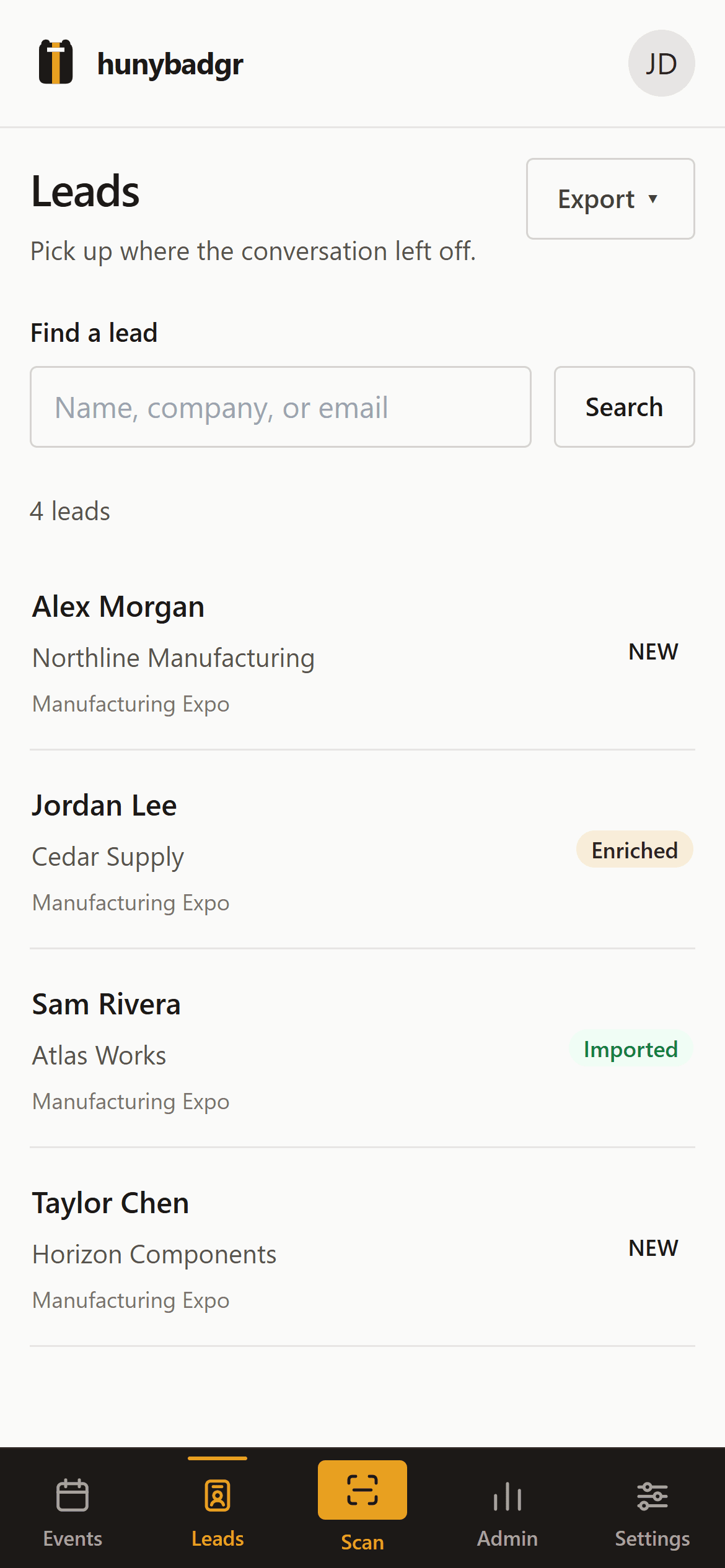
The same idea, a phone camera in place of a rented scanner, is now hunybadgr: trade-show lead capture any team can use without building the workflow themselves.
This is AI Training (Cohort). A twelve-week program for 4 to 12 people who scope, build, deploy, and measure their own automations, with our coaching.
More case studies
All case studiesAutomation & Apps · CoBuild
A shipping container company
An operations lead builds his company’s platform.
A three-person shipping container company wanted one system in place of a patchwork. Their operations lead builds it. We review the architecture, set the pace, and teach the toolchain as it is needed.
13 weeks from first session to a live web inquiry landing in the new system
Automation & Apps · Custom build
A healthcare benefits company
One source of truth for a healthcare benefit, built for HIPAA.
A healthcare benefits company sold through brokers was running sales and member eligibility across five tools and more than ten spreadsheets. We built a CRM and a census management system on one data layer, with protected health information designed in from the first schema.
15 of 15 high-severity security audit findings fixed before release
Automation & Apps · Custom build
A computer refurbishing nonprofit
Memory and processors, inventoried with a phone camera.
A nonprofit that refurbishes retired business computers sells the memory and processors it harvests in lots. We built a scanning tool that reads each part’s label from a photo. A working version was on their bench three days after the discovery meeting.
206 memory modules captured in one scanning session
Automation & Apps · Custom build
A studio furniture maker
A new storefront the team can run without us.
A maker of sculptural studio furniture had outgrown a stock store theme. We rebuilt the storefront around the craft, kept the existing checkout, handed over every account, and wrote the guide that lives inside the admin.
100% of code, hosting, database, and email in the client’s own accounts
Have a process like this one?
Thirty minutes on a call. Bring the process that is eating your week. You will leave knowing which way of working fits, or that none does yet.
Prefer email? erik@civic-dialog.com