Case studies Automation & Apps · Custom build
One source of truth for a healthcare benefit, built for HIPAA.
A healthcare benefits company sold through brokers was running sales and member eligibility across five tools and more than ten spreadsheets. We built a CRM and a census management system on one data layer, with protected health information designed in from the first schema.
A healthcare benefits company. Name withheld.
Result: One record, changed once
- 15 of 15
- high-severity security audit findings fixed before release
- About 200
- census spreadsheets collected by email every month
- 10+
- spreadsheets and five tools holding the same records
- 5
- apps on one data layer: site, CRM, employer portal, admin, operations
Where it started
One contact change, five places to update it.
The company sells a telehealth benefit to employers, mostly through benefits brokers, on a per-employee subscription. About two hundred employer groups depend on one thing being right: the census, the list of who is covered this month.
Every month a coordinator emailed each employer a spreadsheet, asked for it back by the twentieth, reassembled the returned files, reformatted them for the care vendor’s upload, and corrected whatever had been edited along the way. Only a handful of employers used an automated transfer.
01 Discover
Two workshops, one finding
A strategy workshop, then a technology and data workshop with every role that touches a record. The finding fit in one line: there was no single source of truth.
Where the data lived
A marketing CRM, an email platform, the care vendor’s member database, two broker-data tools, and more than ten spreadsheets. Changing one contact meant updating five or more places.
What it cost sales
An enrichment tool was overwriting data people had entered by hand. Sales activity was logged manually. Brokers went cold because nothing prompted a follow-up.
What it cost members
New groups arrived with missing emails and birth dates. When a census update lagged, a covered person could be told they were not eligible.
02 Architect
Own the data layer, fence the PHI
Two rules shaped the design. The company owns its data layer, so any vendor around it can be swapped. And protected health information is mapped before it is stored.
A map of data in transit
The company’s compliance lead held the census work until PHI handling was shown, not described. We mapped every place member data moves and rests, and put each platform in the path on a HIPAA-eligible plan.
Least exposure by default
Social Security numbers are hidden in the interface and blank in exports. Member emails are off unless switched on. Every app sits behind its own sign-in, and an employer’s HR contact works only in their own group’s census.
An audit trail
Edits to member records are logged. A security audit ran before release, and all fifteen of its high-severity findings were fixed.
The data layer
One record per employer, broker, contract, and member
Owned by the company. Every app reads and writes here, so a change is made once and any vendor around it can be replaced.
- Marketing sitePublic
Public pages and lead intake.
- CRMSales
Brokers, employers, contracts, lead briefs, campaigns.
- Employer portalEmployer HR
An HR contact maintains their own census. English and Spanish.
- AdminInternal staff
Census across all groups, batch changes, vendor export and import.
- OperationsScheduled
Scheduled jobs: age-outs, renewals, notifications.
- Care vendorExport
Receives the eligibility file, per employer or all at once.
03 Build
An interim fix, then the system
The coordinator needed relief before the platform existed. So the first thing shipped was a small tool, and the platform followed in short releases.
First, a census splitter
A script that filters the master export to active primary members and writes one file per employer. It removed the reassembly step while the real system was built.
Census management
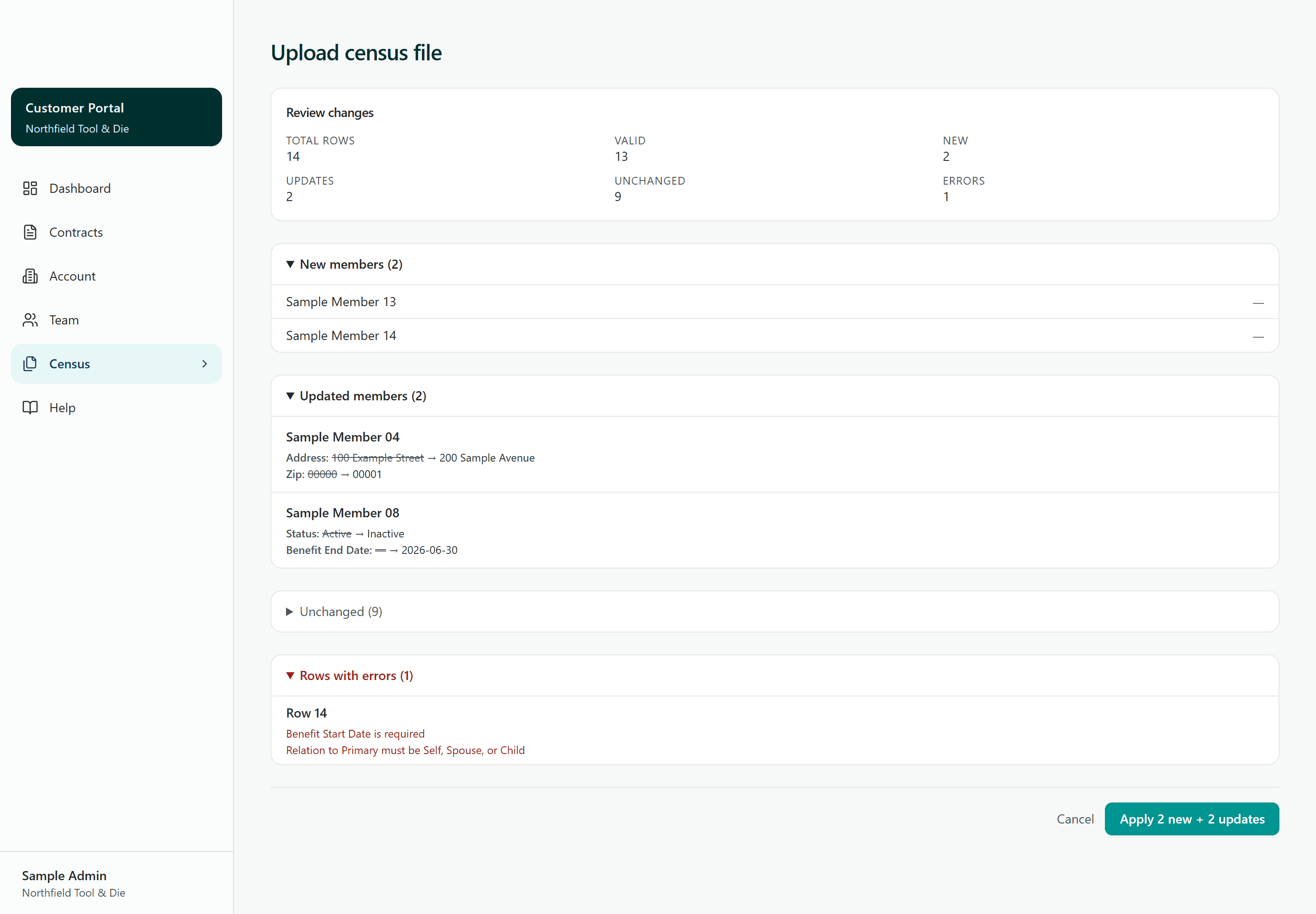
Employers add, edit, and terminate members in a portal, by grid or by upload with a preview of what will change. Dependents age out on schedule. Exports to the care vendor and imports back are built in, with duplicate warnings and name reconciliation.
The CRM
A new lead arrives with a research brief and a notification to the right rep. Contracts are linked to employers. Renewal reminders, welcome and eligibility notices, and planned email campaigns run from the same records.
04 Result
One record, changed once
The CRM and census management run on one data layer. Leads arrive with their research briefs, employers keep their own census in a portal, and the eligibility file for the care vendor is one export.
In a HIPAA build, the person who can say no is part of the team. The company’s compliance lead saw how protected health information moves and rests before any of it was stored.
Collecting changes
- Before
- A spreadsheet emailed to each employer, about 200 a month
- Now
- Employers update their own census in a portal
Catching errors
- Before
- Found after the fact, corrected by hand
- Now
- Upload preview and duplicate warnings before anything is saved
Sending to the care vendor
- Before
- Files reassembled and reformatted by hand
- Now
- One export, per employer or all at once
Changing a contact
- Before
- Five or more places
- Now
- One record
| Step | Before | Now |
|---|---|---|
| Collecting changes | A spreadsheet emailed to each employer, about 200 a month | Employers update their own census in a portal |
| Catching errors | Found after the fact, corrected by hand | Upload preview and duplicate warnings before anything is saved |
| Sending to the care vendor | Files reassembled and reformatted by hand | One export, per employer or all at once |
| Changing a contact | Five or more places | One record |
This is Automation & Apps (CoBuild). Custom automations and internal apps, built in weeks with your stakeholders in the room and anywhere from none to four of your people at the keyboard, on tools and accounts you own.
More case studies
All case studiesAI Training · Cohort
An aerospace manufacturer
A marketing team stops renting badge scanners.
Inside an aerospace manufacturer’s automation cohort, the marketing team mapped what trade-show lead capture cost them each year, then replaced rented badge scanners with a phone form that puts each lead straight into the CRM.
About $80,000 a year, the mapped cost of the old process
Automation & Apps · CoBuild
A shipping container company
An operations lead builds his company’s platform.
A three-person shipping container company wanted one system in place of a patchwork. Their operations lead builds it. We review the architecture, set the pace, and teach the toolchain as it is needed.
13 weeks from first session to a live web inquiry landing in the new system
Automation & Apps · Custom build
A computer refurbishing nonprofit
Memory and processors, inventoried with a phone camera.
A nonprofit that refurbishes retired business computers sells the memory and processors it harvests in lots. We built a scanning tool that reads each part’s label from a photo. A working version was on their bench three days after the discovery meeting.
206 memory modules captured in one scanning session
Automation & Apps · Custom build
A studio furniture maker
A new storefront the team can run without us.
A maker of sculptural studio furniture had outgrown a stock store theme. We rebuilt the storefront around the craft, kept the existing checkout, handed over every account, and wrote the guide that lives inside the admin.
100% of code, hosting, database, and email in the client’s own accounts
Have a process like this one?
Thirty minutes on a call. Bring the process that is eating your week. You will leave knowing which way of working fits, or that none does yet.
Prefer email? erik@civic-dialog.com